A research question I worked on in the OSU Leadership Center with Co-Director Dr. King.
I had to privilege and opportunity to work with Co-Director, Dr. King, of the OSU Leadership Center stationed in the College of Food, Agricultural, & Environmental Sciences within the Ohio State University. This was a question that then turned goal of Dr. King and I was given the lead to develop a framework and potential answer to this question.
From 2017 – 2020, during Donald J. Trump’s presidency, we seen explicit and overt racism and heightened discrimination. Upon the arrival of Covid, in the midst of a rise in police killings and brutality towards Black individuals, we started to see individuals and organizations discuss, argue, stand for (or against), a variety of social justice topics and movements. The biggest movement that we all know is Black Lives Matter. Even though it’s rebutted with “All Lives Matter,” Black Lives Matters is a global network foundation that has forced many uncomfortable conversations. My individuals and organizations recognized the statistical evidence of injustices towards Black individuals and wanted to make an effort in how they can support Black lives and become more educated.
This lead to the question of “how to intentionally incorporate social justice topics into leadership development programs?” This is the question that organizations had as they came into the OSU leadership center to participate in growth/strength based leadership development program.
Taking a running start with this question, I immediately searched for peer reviewed research articles on the topics of social justice and leadership. After much reading and locating common themes, I discovered four articles to start to drive my discussion and foundation towards our framework. Those articles were Exploring Values and Actions: Definitions of Social Justice and the Civic Engagement of Undergraduate Students, Social Justice: A Missing, Unelaborated Dimension in Humanitarian Engineering and Learning Through Service, An Integrative Definition of Leadership, and Using Professional Leadership to Promote Multicultural Understanding and Social Justice.
Although each text gave me a plethora of information to run with and dig through, none gave me a definitive definition of what social justice is. Upon further evaluation I recognized another issue, communication and conflict management. While still searching for a definition of social justice, I discovered that there are two categories. Inter-social treatment which is based on race, gender, age, sexual orientation, etc. Then there’s Unequal Government Regulation which is based on unjust laws and regulations (pachamama.org).
With the help of Dr. King, I then discovered a Social Justice Lens by Cascadia Department of Bioregion that provided a social justice lens checklist which started to help bring everything together. As we laid all of our information out and searched for common themes. We came up with ethical communication model and how this model helps individuals work through difficult discussions on any social justice topic.
I then turned my efforts to interview prominent community leaders and professors. I documented each interview and again searched for common themes that were mentioned as I interviewed each person. Upon my last interview, I realized that I would have to put together some framework that would only attempt to answer the main question as it’s far too complex of an answer. All in all I think I did come up with an answer out developing the frame work.
First, I identified the same basic principles of social justice and leadership. Next I defined principles for leadership and defined them for social justice. I then explained both approaches of social justice and leadership and how they work in tandem with each other to come to an equilibrium. Following, I identified the steps it takes to intentionally incorporate social justice topics in leadership development. I explained each step and then showed how the ethical communication model is to be applied as one is moving up each step. Lastly, I shared common key factors that are going to effect the lens of social justice no matter what social justice topic is being discussed and incorporated into development and programming.
Check out the principles & steps below and formulate your own opinion and answer to this question:
Basic principles of Leadership:
- Purpose
- Responsibility
- Change
- Value
- Challenge
- Diversity
- Access
- EqualityEquityInclusion
Basic principles of SJ:
- Purpose
- Responsibility
- Change
- Value
- Challenge
- Diversity
- Access
- EqualityEquityInclusion
Definitions of Principles for Leadership:
- Purpose – The leadership is rooted in creating a change for a specific reason.
- Responsibility – The leader has a duty to spark influence or create change.
- Change – The reason for leadership taking its stance/position of being the driving force.
- Value – Aware of the worth that will exist after change has taken effect, the worth of the people, and worth of the topic.
- Challenge – Challenging the status quo.
- Diversity – Knowing that it’ll take different styles of leadership, education, and collection of people to be effective.
- Access – Creating the pathway to exposure, participation, and opportunity.
- EqualityEquityInclusion
Definitions of Principles of Social Justice:
- Purpose – The driving force of pushing for change or transformation.
- Responsibility – Creating accountability for change or transformation.
- Change – Recognizing injustice or problem that is be addressed and fixed.
- Value – Aware of the worth that will exist after change has taken effect, the worth of the people, and the worth of the topic.
- Challenge – Challenging the injustice, problem, status quo.
- Diversity – Addressing a collective group of people to bring forth change.
- Access – Creating the pathway to exposure, participation, and opportunity.
- EqualityEquityInclusion
Both approaches are strength based with understanding the point of view and weaknesses present.
Both approach ethics based on one’s individual experience (what may seem ethical to one, may not seem to another).
Leaders have to become an incubator for Social Justice. Social Justice is a collective effort, and everyone plays a role.
Leadership and Social Justice work in tandem to come to a balanced view of understanding
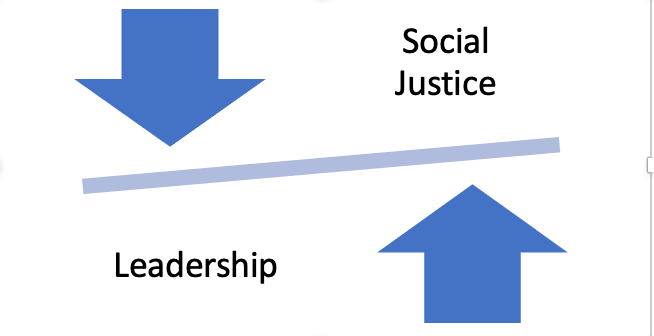
Steps to intentionally incorporate Social Justice topics in Leadership Development
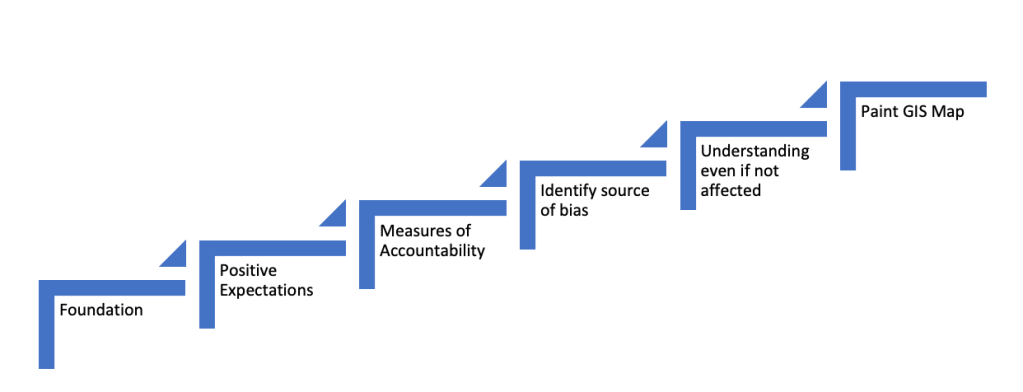
6 Steps to intentionally incorporate Social Justice topics into Leadership Development Programs
- Start with your foundation of social justice and leadership, using the basic principles. Then build your foundation to create the environment and platform of discussion and listening for the specific social justice topic.
- State expectations and set them. Reinforce the positive outcomes/objectives that are to be achieved upon movement through the framework.
- Create measures of accountability guiding each individual through a step of individual accountability.
- Identify the source of one’s own implicit bias
- Provide understanding why the issue is an issue even if one isn’t affected or disinterested
- Create a map showing how leadership drives social justice. Use a GIS mapping to show all of the layers impacting and effected by social justice issue.
Ethical Communication Model to implement while climbing each step
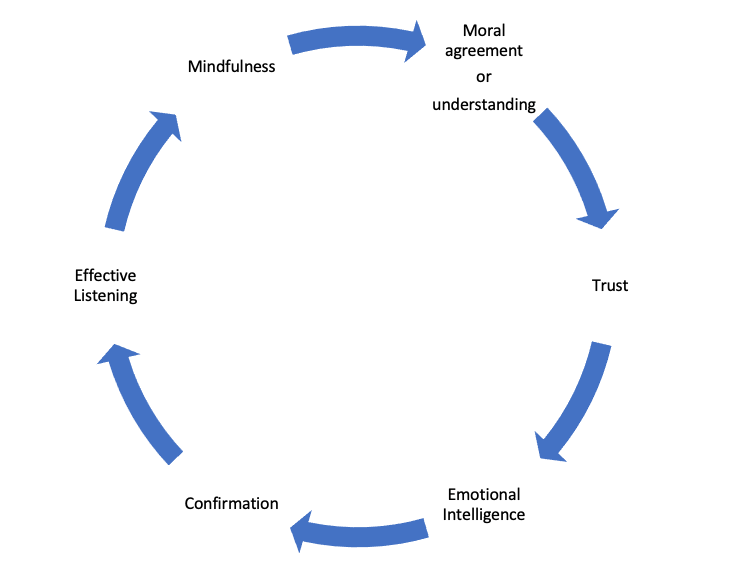
Common Key Factors:
- “How do you engage with yourself for difficult discussions?”
- Neurodiversity, providing understanding for all intellectual levels.
- Layman terms and being aware of education privilege.
- Recognize there’s a level of impossibility when coming to an agreement or understanding.
- i.e. race/ethnicity, sexual orientation, cultural.
- Respect and value one’s individual experience.
- Using the proper social justice lens: Access, Agency, Advocacy, or Solidarity Action to place social justice in one these areas, if not all areas.
- Helping build the ability to reflect to process change or transformation.
- Addressing the structural issues that perpetuate separation and hierarchy.
 SG's Leadership Suite